 |
 |
 |
 |
 |
 |
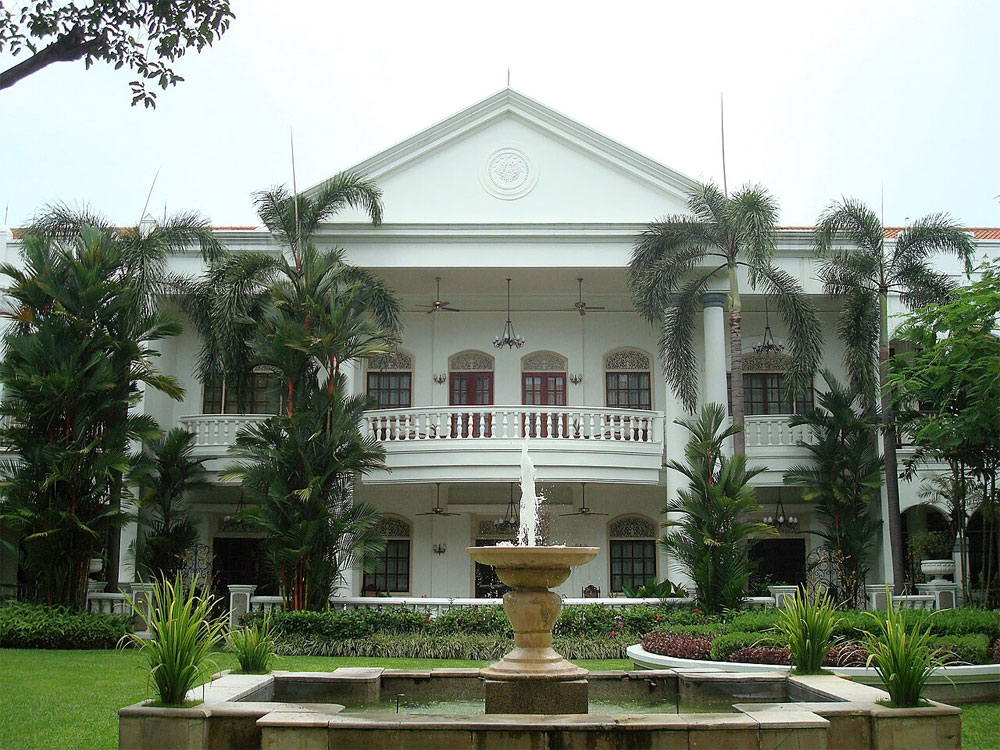
Majapahit Hotel
The hotel was founded in 1910 as the Hotel Oranje by Lucas Martin Sarkies, the son of Martin Sarkies of the Sarkies brothers,[2] who commissioned Regent Alfred John Bidwell to design the hotel. It opened on 1 July 1911.[3] Two wings were added from 1923 to 1926 and an Art Deco lobby extension was opened in 1930. The opening was celebrated with a royal party attended by Crown Prince Leopold III from Belgium, Princess Astrid from Sweden and Charlie Chaplin.
The most significant part of the hotel's history took place at the end of World War II. On September 19th, 1945 at 6am, the Dutch leaders in Surabaya raised the Dutch red-white-blue flag on the main flag pole of the hotel. It was a symbol to show Dutch colonial control after the allies' victory in World War II. Indonesians considered the raising of the Dutch flag on top of the hotel as an insult to Indonesia's proclamation of independence, which was made in Jakarta on August 17th. By 6.30am, a crowd of angry Indonesians who had gathered in front promptly raised a cry of 'Merdeka' (freedom), lowered the offending flag, and tore off the bottom of blue strip, thus turning it into the Indonesian flag. Confusion and tragedy ensued. A British commander was murdered in October and a full scale invasion was launched the following month, beginning on November 10th 1945. This day is celebrated nationally as Heroes Day and Surabaya is called 'The City of Heroes' with an appropriate monument to mark the famous battle. For the next few months, while the revolution carried on in Surabaya, the hotel was known as Hotel Merdeka or the Liberty Hotel. By 1946 the hotel was again managed by the Sarkies family and underwent yet another name change to Hotel L.M.S (after its founder Lucas Martin Sarkies).
In 1969, Mantrust Holdings Co. bought the hotel and renamed it Hotel Majapahit, after the historic kingdom of Majapahit. The hotel was restored in 1994 by Harry Susilo, a prominent local ethnic Chinese businessman, at a cost of $51 million. It reopened in 1996 as the Mandarin Oriental Hotel Majapahit Surabaya, managed by the Mandarin Oriental Hotel Group. It was bought by the CCM Group in 2006 and renamed Hotel Majapahit. It is now managed by Accor
|
|
|
|
|
|
Surabaya

A major port and the capital of east Java, Surabaya is the second-largest city in Indonesia and now extends well beyond its old city walls. Spice market, Surabaya The old town is the highlight. Chinese temples, a lively Arab Quarter, an ancient mosque and a tobacco museum are all interesting ways to occupy your time here. For the more adventurous there is a short ferry ride to Madura Island where, in the summer months, the exhilarating spectacle of bull racing occurs every weekend.
Surabaya is like a bottle of wine: it gets better the more you get to know it. Give it time and you'll discover that Surabaya has many quixotic corners of interest. Its historic Arab Quarter is a fascinating labyrinth of lanes, and the city has one of Indonesia’s biggest Chinatowns and some interesting, though disintegrating, Dutch colonial buildings.
| Monumen Tugu Pahlawan |  |
Monumen Tugu Pahlawan dan Museum Sepuluh is a 41-meter obelisk built to commemorate the Battle of Surabaya on November 10, 1945. Underground Museum Sepuluh Nopember containing photos, dioramas, and weapons from the Indonesian National Revolution. Expansive green plaza surrounding the monument. | |
| Monumen Kapal Selam Surabaya |  |
Monumen Kapal Selam Surabaya features KRI Pasopati 410, a decommissioned Soviet-era Whiskey-class submarine used by the Indonesian Navy. Interactive walkthrough of the interior, including the control room and torpedo chambers. Educational film screenings detailing naval battles in the Aru Sea. | |
| Sunan Ampel Great Mosque |  |
Sunan Ampel Great Mosque is the oldest mosque in East Java, originally constructed in 1421. Located inside Kampung Arab, a district characterized by narrow alleyways selling Middle Eastern goods, spices, and street food. Burial site of Sunan Ampel, one of the nine Islamic saints (Wali Songo) who introduced Islam to Java. | |
| Muhammad Cheng Hoo Mosque |  |
A unique house of worship built to honor the Chinese-Muslim Admiral Zheng He. Blends traditional Chinese pagoda architectural elements with Islamic design. Bright red, green, and yellow exterior detailing with Chinese calligraphy. | |
| Sanggar Agung Temple |  |
A Chinese temple situated on the edge of Kenjeran Beach. Features a 20-meter statue of Guan Yin overlooking the sea, flanked by two large dragon sculptures. Scenic ocean views and surrounding parkland. | |
| Suramadu Bridge | 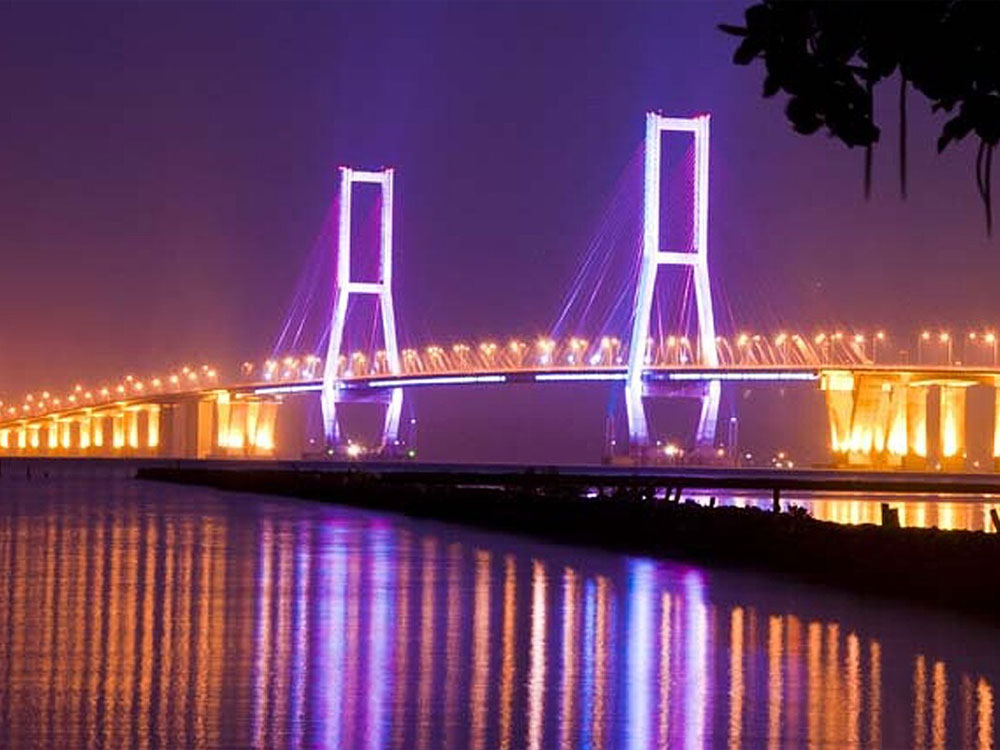 |
spans 5.4 kilometers across the Madura Strait, connecting Surabaya to Madura Island. Longest bridge in Indonesia. Panoramic coastal views during the day and decorative illumination at night. It provides the access point from the Surabaya side along Tambak Wedi for viewing the structure over the water. Waterfront vantage points for photography. Nearby street food stalls offering local East Javanese snacks along the coast. | |
| Atom Market Shopping Mall, |  |
Market Mega-malls and modern shopping centres are in Surabaya’s every corner, but Atom Market still holds a special place throughout the city’s history. Established in 1972, many locals and tourists still prefer this market to get cheap and locally made goods, from fashion to electronics. The market also serves as a large culinary centre where tourists can sample all kinds of traditional sweets, snacks, and meals. |
To get a larger photo, click on one of the thumbnails below
To get a larger photo, click on one of the thumbnails below